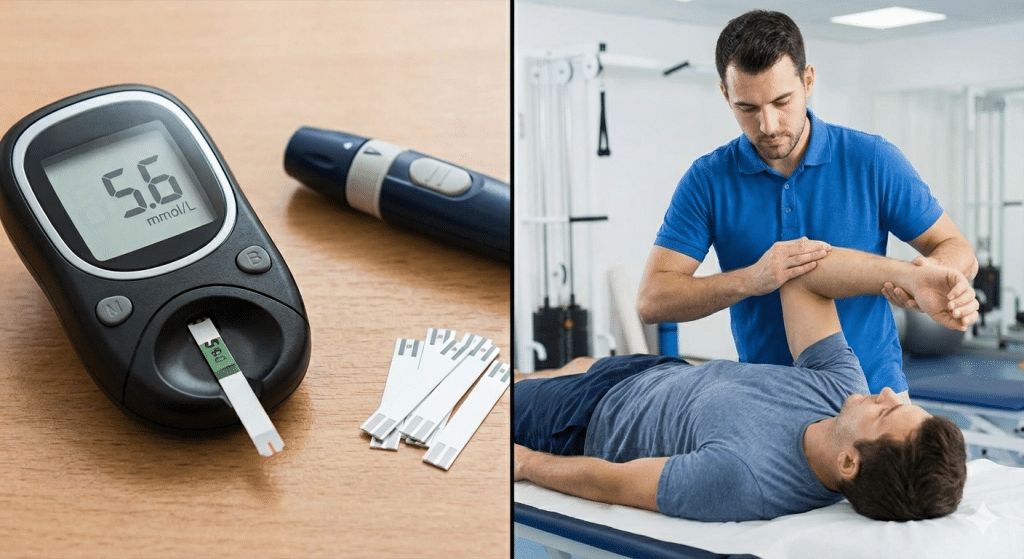
If you’ve been dealing with a stubborn tendon injury, ongoing joint pain, or a musculoskeletal problem that just won’t shift despite doing everything right, this might help explain why.
Your blood sugar levels could be quietly holding you back from healing properly—even if your GP has told you everything looks normal.
This isn’t about diabetes. This is about understanding how your body’s metabolic health directly affects your ability to repair tissue, manage inflammation, and recover from injury.
And it’s one of the most overlooked pieces of the puzzle in physiotherapy.
WHAT DOES BLOOD SUGAR HAVE TO DO WITH HEALING?
When most people think about blood sugar, they assume it only matters if you’re diabetic or heading that way. But research shows that even small increases in blood sugar—well within what doctors consider normal—can significantly slow down your body’s ability to heal.

Your blood sugar levels affect tissue healing in three important ways:
Collagen production: Blood sugar affects how well your body makes and repairs collagen, which is the main structural protein in tendons, ligaments, and cartilage. When blood sugar runs higher than ideal, collagen production slows down and the quality of new tissue isn’t as good.
Inflammation control: Higher blood sugar drives inflammation throughout your body. This inflammatory state interferes with tissue repair and can make pain worse, even when the original injury should have healed by now.
Tissue quality: When blood sugar levels rise, glucose molecules stick to proteins in your body, forming compounds called advanced glycation end products (or AGEs). These AGEs build up in tendons and other tissues, making them stiffer, weaker, and less able to handle load.
This isn’t just theory. This is actually happening in people whose blood tests would come back completely normal from their GP.
THE PROBLEM WITH 'NORMAL' RANGES
Here’s where it gets interesting.
The reference ranges used by the NHS are designed to detect disease. They’re set wide enough to flag people who are diabetic or at high risk of becoming diabetic. But they’re not designed to pick up the subtle metabolic issues that affect tissue healing in otherwise fit and healthy people.
Take HbA1c, which measures your average blood sugar over the past three months. The NHS considers anything under 42 millimoles per mole to be normal. But research shows that HbA1c levels above 37 millimoles per mole are linked with slower collagen production and delayed tendon healing.
That means someone with an HbA1c of 39 would be told everything is fine, when in reality their blood sugar levels are high enough to slow tissue repair by up to 23 percent.
These aren’t diabetic levels. These are subtle elevations that conventional testing doesn’t flag because it’s not looking for them.
HOW BLOOD SUGAR AFFECTS SPECIFIC PROBLEMS
TENDON INJURIES
Tendons are particularly vulnerable to blood sugar issues because they don’t have a great blood supply and rely heavily on efficient collagen turnover to heal.
Research shows that those AGEs we mentioned earlier start building up in tendons when HbA1c goes above 36 millimoles per mole. These compounds change the mechanical properties of the tendon, reducing its strength and making it more prone to injury and slower to heal.
If you’ve been dealing with a tendon problem for months, doing all the right exercises, managing your activity levels carefully, and still not making the progress you’d expect, this could be the missing piece.
OSTEOARTHRITIC JOINT PAIN
Osteoarthritis is commonly misdescribed as mechanical wear and tear. Recent research shows it’s fundamentally a metabolic and inflammatory condition, not simply the result of joint overuse.
Metabolic health plays a significant role in driving the inflammation that makes osteoarthritic pain worse. Studies show that 40 percent of people with osteoarthritis have underlying issues with how their body handles insulin, and this metabolic dysfunction predicts worse pain outcomes regardless of body weight.
This means it’s not just about how much load the joint is carrying. It’s about the metabolic environment the joint is sitting in.
POST-SURGICAL RECOVERY
If you’ve had surgery—whether it’s a joint replacement, ligament reconstruction, or any other procedure—your metabolic health will influence how well you recover.
The spikes in blood sugar that happen after eating are linked with increased inflammatory markers in your body. These inflammatory markers directly interfere with tissue repair and can slow down your recovery from surgery.
Even if your fasting blood sugar looks normal, what happens after you eat matters.
WHY WE LOOK AT THE WHOLE SYSTEM
At Cornwall Physio, we don’t just look at the injury site. We look at the whole system.
Your nervous system, your metabolic health, your gut function, your hormone balance, and your inflammatory status all influence how well you heal. Blood sugar regulation sits at the centre of this web because it affects nearly every other system in your body.
When we’re working with someone who has a persistent injury, we’re not just looking at movement patterns and tissue loading. We’re asking: what’s happening metabolically that might be preventing this tissue from healing?
This is where we think deeper than standard clinics. It’s not about diagnosing metabolic disease. It’s about optimising the conditions for recovery.
FAQ's
If you want to check whether your metabolic health is affecting your recovery, the most useful starting point is HbA1c and fasting glucose. Ideally, you’d also look at thyroid function, liver markers, a full lipid panel, and other key nutritional and metabolic indicators to see the complete picture.
These aren’t tests your GP will typically run unless you have symptoms of disease, so private testing is often the most practical option. Through our Performance Health® programmes , we organise comprehensive blood panels that measure all the markers relating to every aspect of health and nutrition, interpreted through optimal ranges, not just conventional normal ranges.
Absolutely. For most people with subtle blood sugar issues, lifestyle changes are highly effective. This includes adjusting your diet to reduce blood sugar spikes after meals, increasing movement throughout the day, improving sleep quality, and managing stress.
We also now offer a natural, fibre-based supplement at the clinic that supports gut health and helps stabilise blood sugar. It’s suitable for people with type 2 diabetes as well as fit, healthy people who want to optimise their blood sugar control.
This varies depending on the individual and the severity of the injury, but most people start to notice improvements in symptoms within four to eight weeks of optimising their metabolic health. Tissue remodelling takes longer, so full recovery might take several months, but the trajectory changes.
Your GP can test HbA1c and fasting glucose, but they’re unlikely to run a comprehensive panel covering thyroid, liver, full lipid profile, and nutritional markers unless you have specific symptoms. More importantly, GPs interpret results based on conventional reference ranges, not optimal ranges for tissue healing.
If you’re interested in understanding your metabolic health from a functional perspective, private testing through Performance Health is usually the better option.
No. Metabolic issues can occur in people of any body weight. You can have normal body weight and still have problems with insulin handling, elevated HbA1c, or blood sugar spikes after meals that affect tissue healing.
This is why we don’t rely on BMI or appearance to assess metabolic health. We look at the actual data.
CONCLUSION
Blood sugar regulation isn’t just about preventing diabetes. It’s about creating the metabolic conditions that allow your body to heal efficiently.
If you’ve been struggling with a persistent injury, chronic pain, or slow recovery from surgery, and your response to treatment has been slower than expected, your metabolic health might be the missing link.
This isn’t about finding a disease. It’s about optimising function. And for many people, that’s the difference between an injury that drags on for months and one that finally resolves.
If you’re curious about whether your metabolic health is affecting your recovery, the first step is getting the right tests done and interpreting them through a functional lens, not just a conventional one.
REFERENCES
- Snedeker JG, Gautieri A. The role of collagen crosslinks in ageing and diabetes – the good, the bad, and the ugly. Muscles Ligaments Tendons J. 2014;4(3):303-308. (Related to HbA1c and collagen synthesis)
- Courties A, Sellam J, Berenbaum F. Metabolic syndrome-associated osteoarthritis. Curr Opin Rheumatol. 2017;29(2):214-222. (Related to insulin resistance in osteoarthritis)
- Klass BR, Grobbelaar AO, Rolfe KJ. Transforming growth factor beta1 signalling, wound healing and repair: a multifunctional cytokine with clinical implications for wound repair, a delicate balance. Postgrad Med J. 2009;85(1003):9-14. (Related to AGEs and tendon structure)
- Scott A, Backman LJ, Speed C. Tendinopathy: Update on Pathophysiology. J Orthop Sports Phys Ther. 2015;45(11):833-841. (Related to metabolic factors in tendinopathy)
If you’re dealing with a persistent injury and want to understand whether your metabolic health is affecting your recovery, get in touch. We can organise comprehensive blood work and help you interpret the results through a functional lens.
Schedule a free discovery call with Lou to discuss your suitability for our gut and metabolic health supplement or for our Performance Health programmes.
Interested in our natural, fibre-based supplement for gut health and blood sugar support? You can learn more and purchase here.