Force
How much each leg can produce, muscle group by muscle group, including the hamstrings, quads and groin.
Performance testing · Hyrox and fitness racing
Most Hyrox athletes who plateau are not undertraining. They are training around something they cannot see: a running technique that leaks energy on every one of the eight runs, or a leg that produces force too slowly. We measure how you run with The Run Lab® 3D gait analysis and what each leg can do with VALD® performance testing, then build your training and treatment around what the numbers show.
The short answer
Hyrox performance testing at Cornwall Physio measures how you run and what each leg can do. The Run Lab® 3D gait analysis shows the forces going through every joint and how efficient your technique is across the eight runs. VALD® performance testing measures how much force each leg produces, how fast, and how the two sides compare. You leave with your numbers explained by a specialist physiotherapist, written recommendations on what to train, and a pathway that says when to retest.
About half of a Hyrox race is running: 8 km in eight pieces, and for a 90-minute athlete around 45 minutes on the run. It is where the field separates, and in our experience the athletes who take the most off their time are usually the ones who work on their running. The stations then stack fatigue on top of it. When one leg is quietly out-performing the other, the stronger side does more and more of the work as the race goes on, and that gap is usually invisible until it is measured.
Progress compounds when movement patterns are sound. Any compensation leaks performance through the weaker side, and the weaker side is also where the next injury tends to happen. Finding it before it becomes the injury that pulls you out of a race block is the whole point of testing first and training second.
The race
A Hyrox race is eight 1 km runs, each one followed by a workout station: SkiErg, sled push, sled pull, burpee broad jumps, rowing, farmers carry, sandbag lunges and wall balls. The stations get the attention in training. The running takes about half of the total race time at every level, and every run after the first is done on legs the stations have already taxed.
In Rox Lyfe's analysis of the fifteen fastest Pro performances, running took 52 per cent of an elite man's race (31 of 59 minutes) and 47 to 49 per cent of an average finisher's, who also lost a further two and a half to four minutes on foot in the Roxzone.
Analysis published by VALD Performance of the top fifty Hyrox athletes found that running accounted for 30 to 40 per cent of the time separating the top fifteen finishers, with the gap opening most in the later stages of the race.
When you run, your foot is on the ground for about a quarter of a second. That is the whole window a leg gets to absorb your body weight and push you on, and full strength takes longer than that to arrive. So the question for a Hyrox athlete is how quickly each leg can produce force, not only how much force it has. As you tire, force arrives more slowly and any left to right difference gets bigger. That is often when the hamstring goes in the closing stages, or the same knee flares on the seventh run.
Being strong in the gym does not answer it. Two athletes can be equally strong and only one of them can produce that force fast. That difference only shows when you measure it on a force plate.
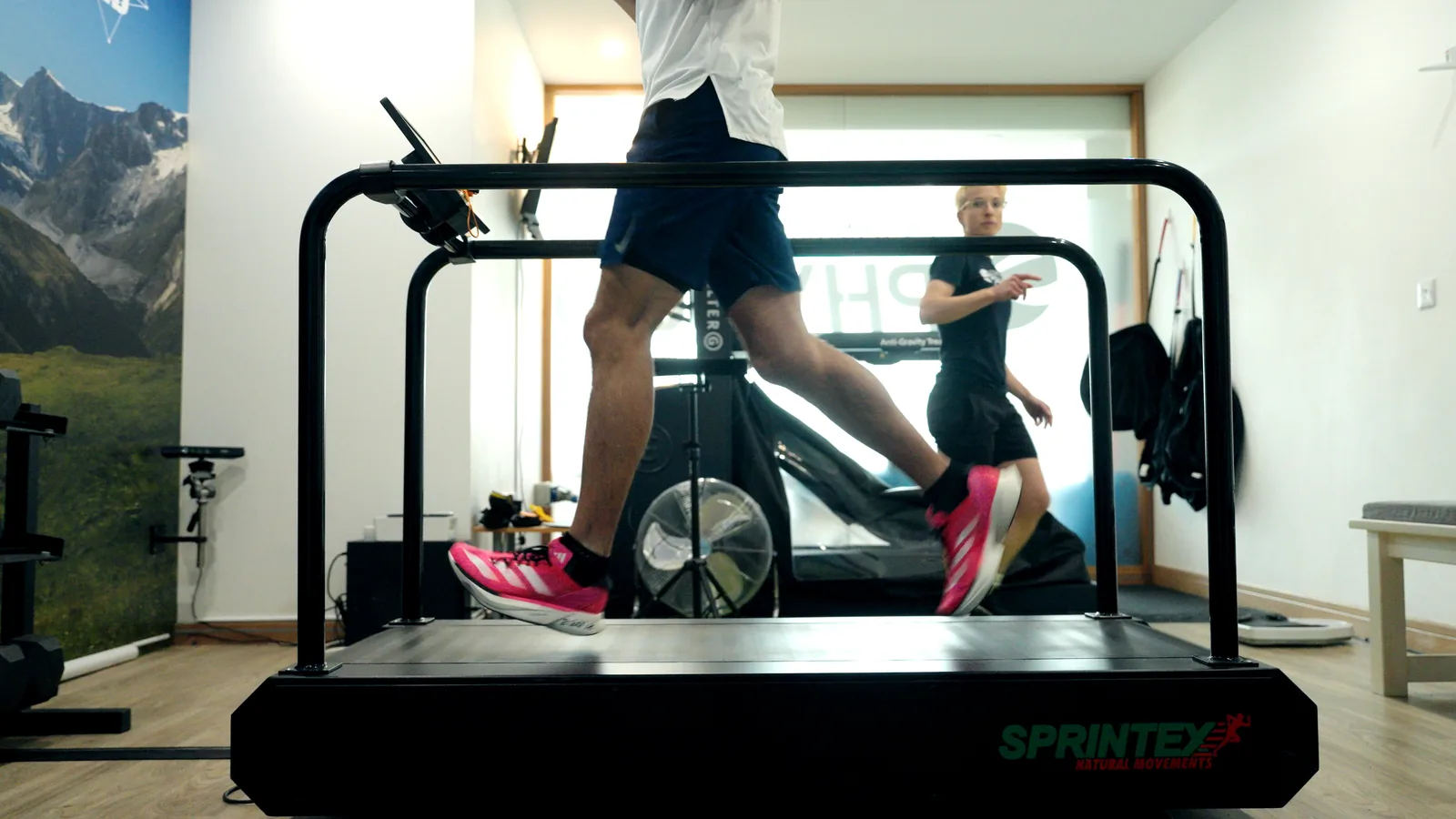
Half the race is running
The Run Lab® is our 3D gait analysis. You run on the treadmill while motion capture records every stride: the forces and angles going through each joint, how well you produce force and absorb it, and how efficient your technique is. For a Hyrox athlete it matters because you run 8 km in eight pieces under growing fatigue, and technique that wastes energy on the first run costs you far more by the eighth.
We often start a Hyrox pathway in The Run Lab® when the running is where the time is going or where the niggles show up: run splits that fade from run four or five onwards, a pace that will not come down however much you train, or calves, Achilles, shins, knees, hips or lower back that complain on the runs rather than the stations. What comes out of it is specific: the changes to technique and loading that make each stride cheaper, drills to build them in, and follow-up sessions to check they have stuck. For athletes like this, The Run Lab® is either the first session or a fixed part of the pathway.
VALD® testing and The Run Lab® are different tools. The Run Lab® shows how you run. VALD measures what each leg can do. Most Hyrox pathways use both, in the order your goals and injury history call for.
The other half: force and symmetry
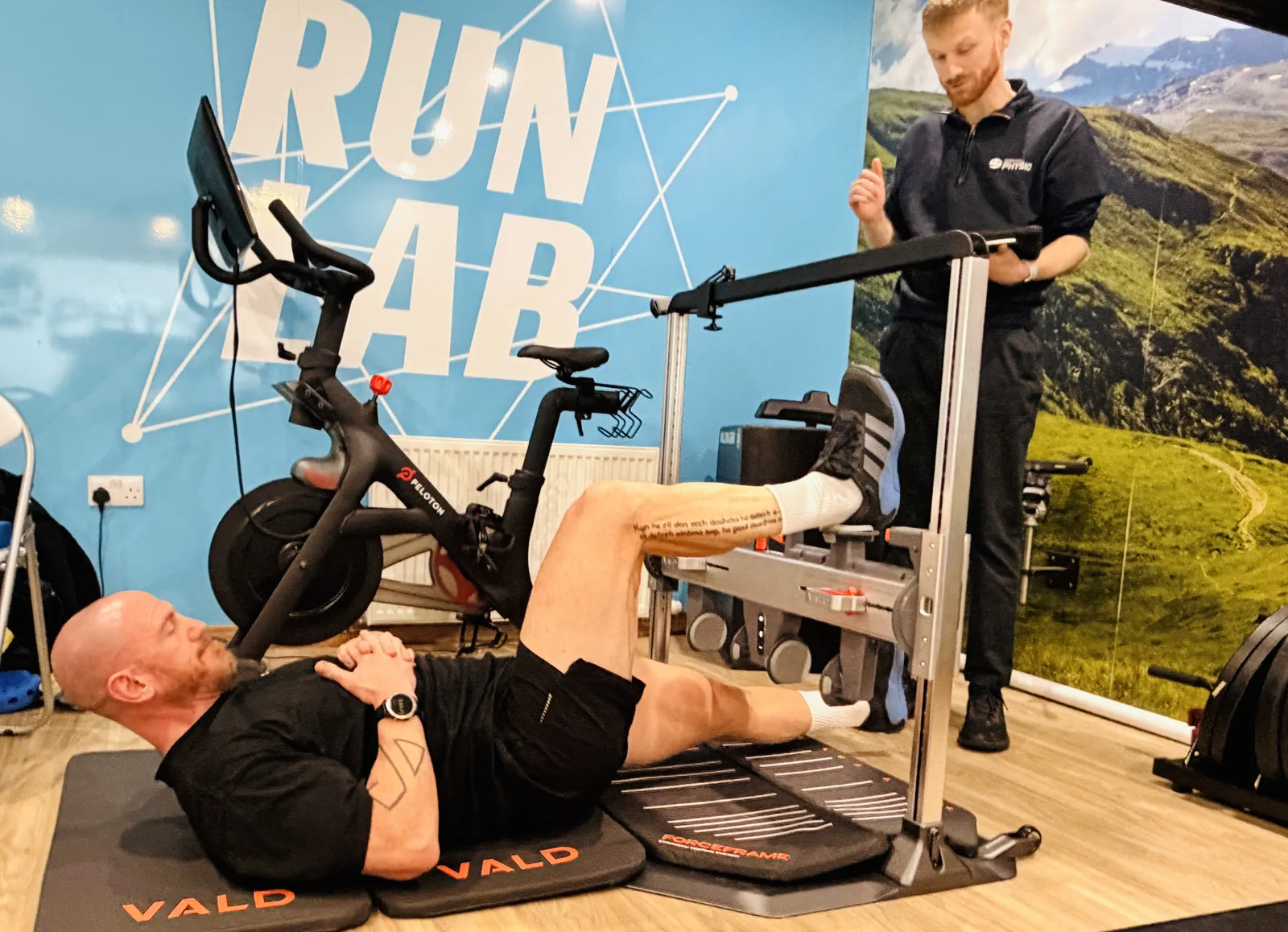
VALD is the force testing system used across professional sport. Our movement lab in Carlyon Bay has the full suite: ForceDecks force plates, the ForceFrame strength rig and handheld dynamometry. We use them together, as a series of short movement screens, to piece together what each leg is doing. A therapist runs every test and your numbers come up on screen as you go.
We compare every measure against athlete populations, so you can see where your strengths and weaknesses sit and where to spend your training attention.
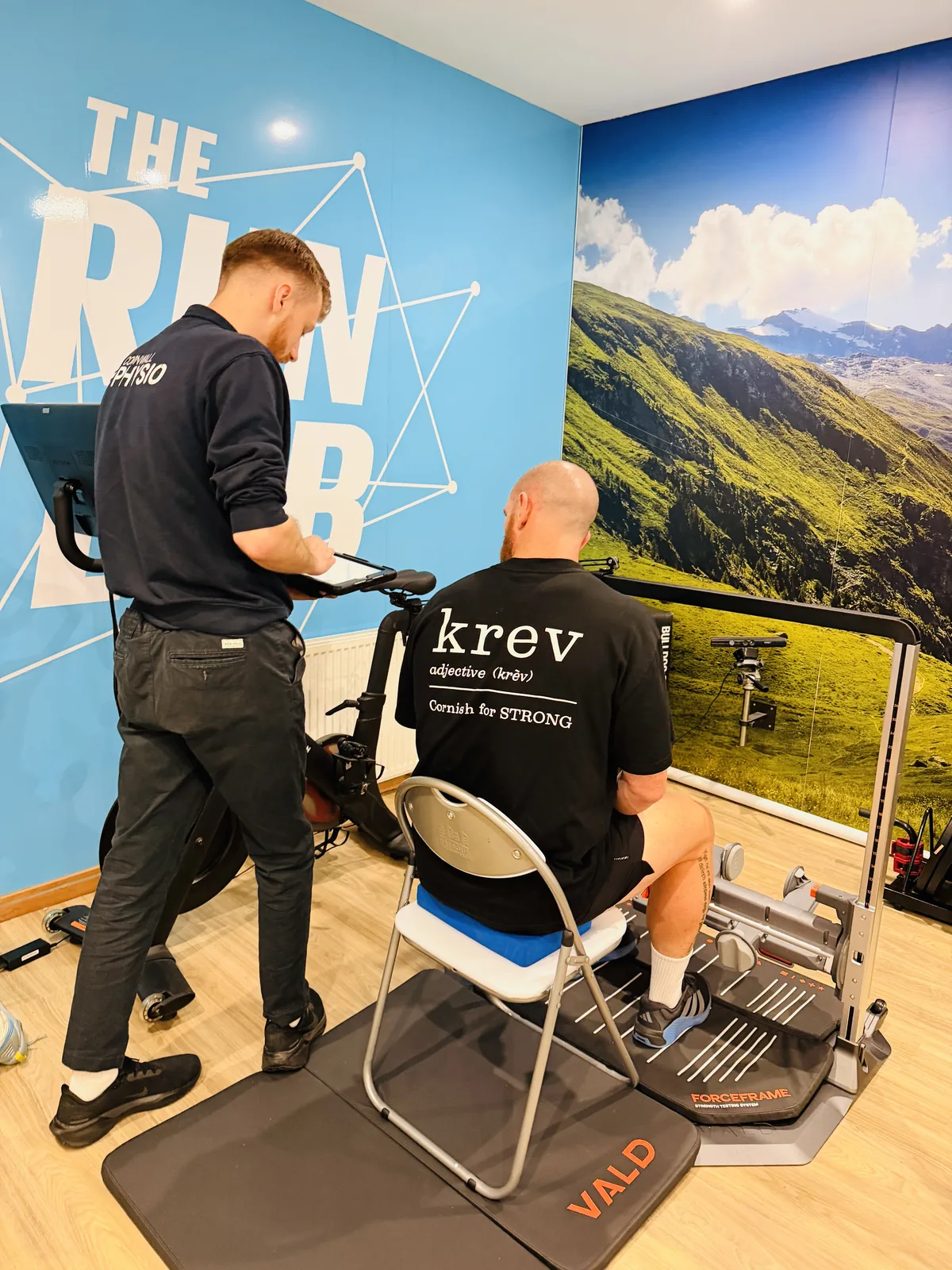
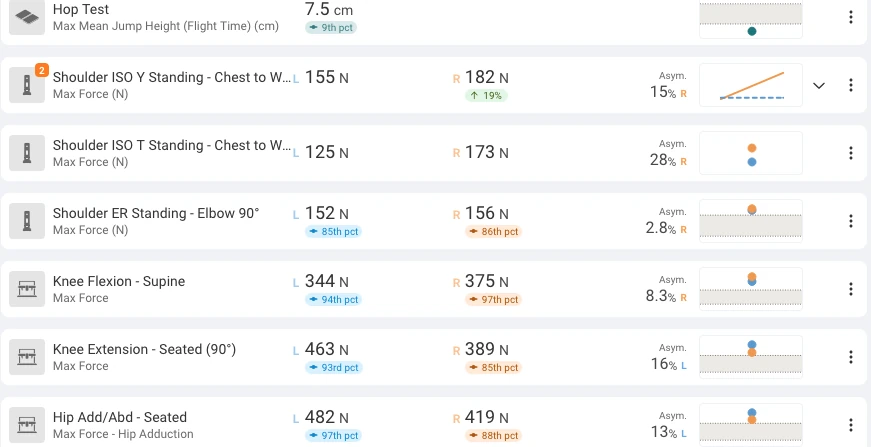
How much each leg can produce, muscle group by muscle group, including the hamstrings, quads and groin.
How fast that force arrives. This is the measure that decides a sled push, a wall ball and every stride once you are tired, and it is the one a standard strength test misses.
The gap between your sides on each test. A commonly used benchmark in sports science is to keep it under ten per cent on the measure that matters for your sport. The evidence on how well asymmetry predicts injury is mixed, but above that level performance starts to leak through the weaker side, particularly under fatigue.
How well you land and recycle force, which is what protects the knees, calves and Achilles across eight runs.
How it connects
The four steps are one pathway rather than four separate services, and we design it around your race calendar.
We start with your injury history and your race goals, because that conversation shapes how we read the data. If the running is where you are losing time or where the niggles show up, you start in The Run Lab®. If the question is strength, power or one side doing more of the work, you start with VALD®. Most pathways include both.
Once the deficit is mapped, the fix is targeted work on the weak side, layered into your existing programme rather than replacing it. Your results email says what to work on, for example building strength in the right quad and adding plyometric work twice a week. The specific exercises come from your physiotherapist, one to one.
The first test is the baseline the rest of the season is measured against. Follow-up sessions in The Run Lab® or on VALD® let us watch the gap close, check a technique change has stuck under fatigue, catch a new compensation early and adjust your strength and rehab work as the block progresses.
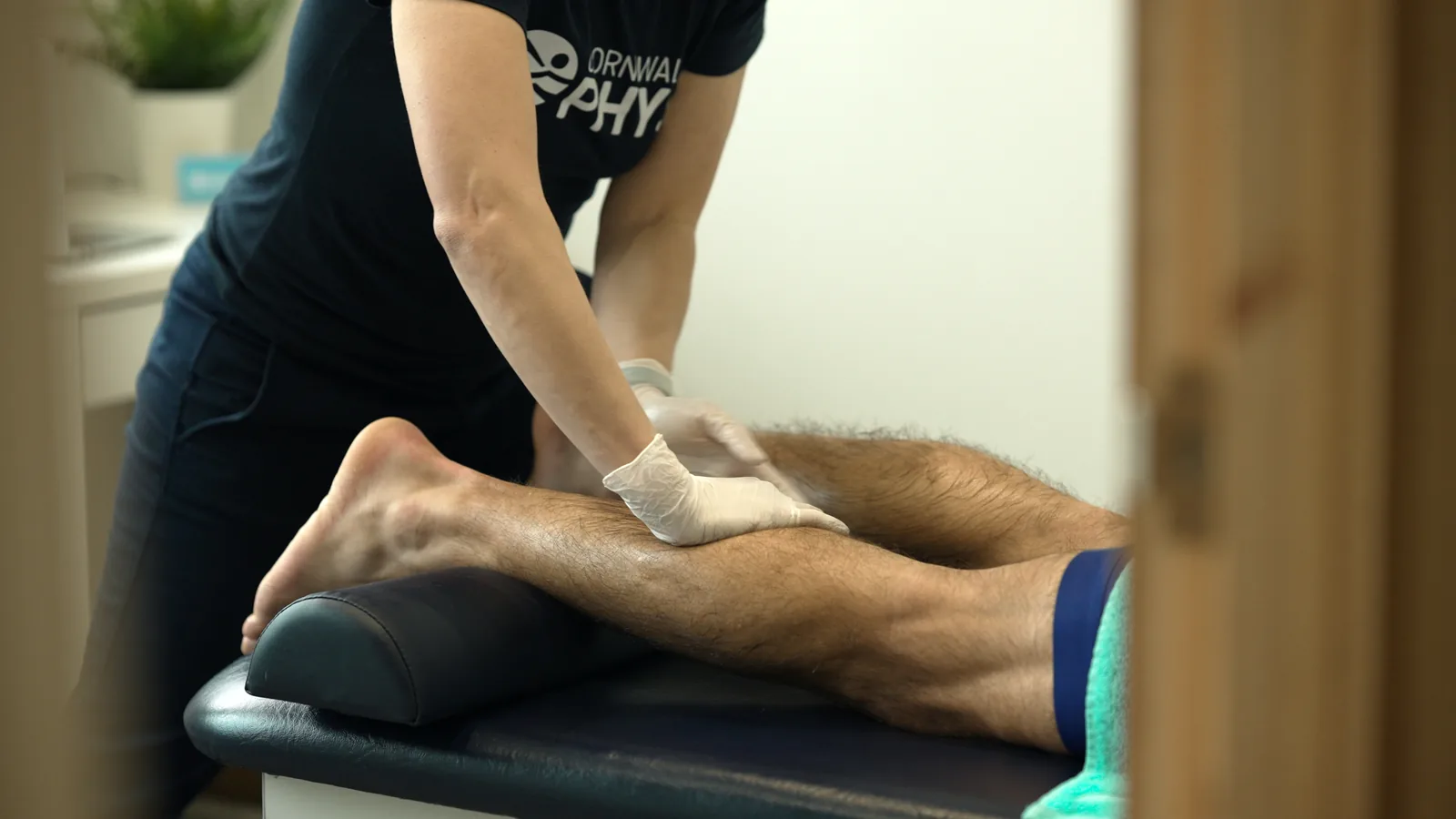
Athletes at Cornwall Physio stay in race shape with regular maintenance treatment from our specialist therapists, so tightness is dealt with when it appears. If a new problem turns up mid-season, we diagnose it on the day and treat it with whichever of our advanced treatments the case calls for.
What you get: training that builds on itself, fewer training weeks lost to injury, and a clear path to your next PB.
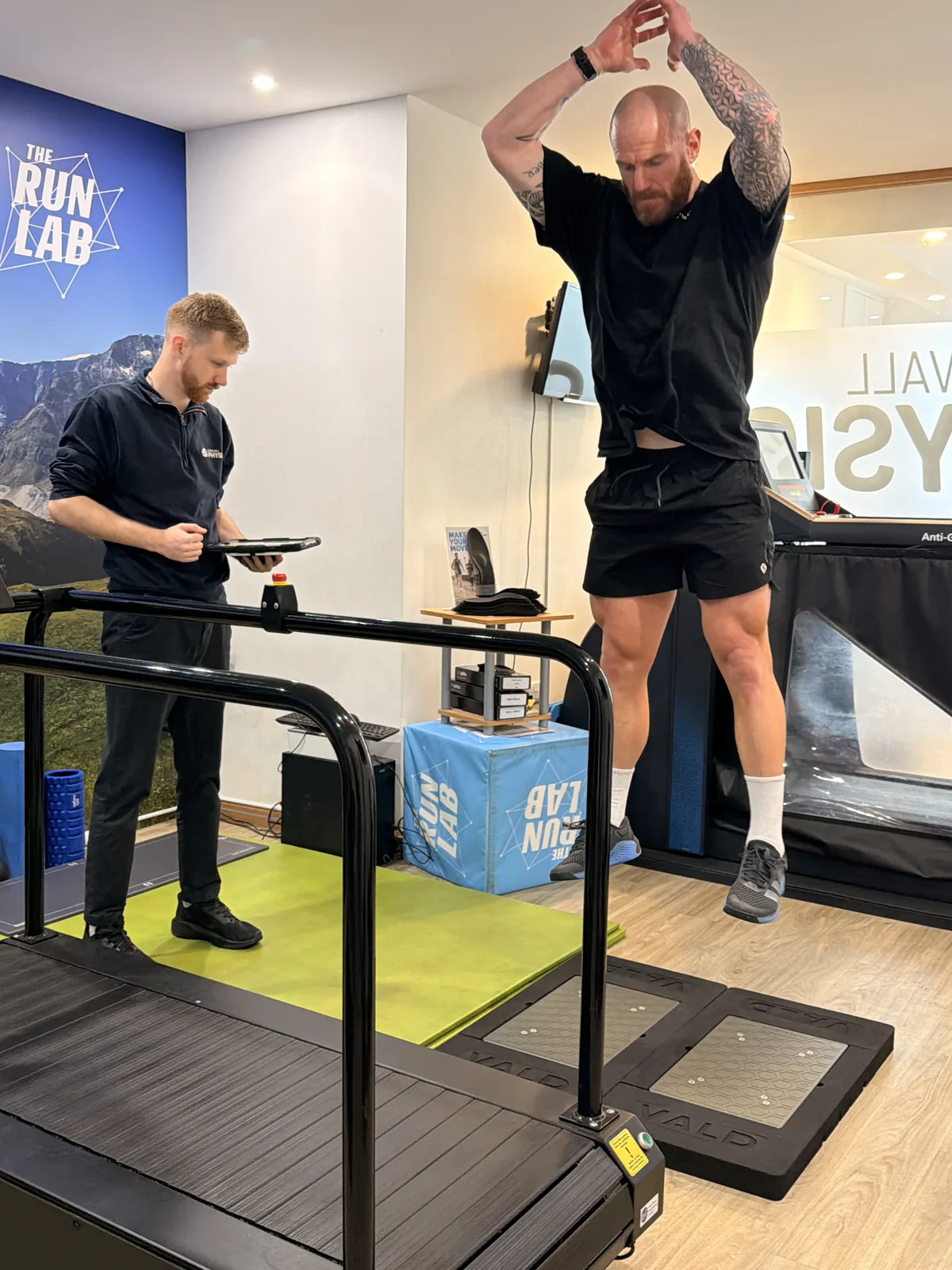
From the lab
Who it is for
A baseline before your first block means the programme builds on a body that has been checked, and race day is not the first time you find out where the weak side is.
If your time has stalled, the most likely reason is not your programming. It is a movement deficit your programming was never told about, and on the runs, which are half the race, it is often a technique that costs more with every kilometre.
Strong on the stations, but the run splits drift from run four or five onwards. The Run Lab® shows what fatigue is doing to your technique and what to change so the later runs hold.
Calves, Achilles, shins, knees, hips or lower back that complain on the runs rather than the stations often trace back to how each stride is loaded. We measure it, change it and treat what needs treating.
Testing helps us judge when a leg is ready to load again, measured against your other side and against athletes like you, rather than on how it feels on a good day.
Partners can test together, and we run group testing evenings for gyms and clubs: six athletes at a time, a live leaderboard on the night, and a group debrief showing what the group has in common. Coaches are welcome.
Getting started
Not sure whether to start with VALD® or The Run Lab®? Tell us your race date and what has been bothering you when you enquire and we will recommend the starting point.
Free guide
Optimising your Performance for Hyrox and Fitness Racing is our free guide for Hyrox and fitness racing athletes. It sets out the four-step pathway, what a VALD® session and a Run Lab® session each measure, and two athlete examples from the lab. Written by Lou Nicholettos, founder of Cornwall Physio and The Run Lab®.
Common questions
Hyrox performance testing is a set of objective movement tests that measure how you run and what each leg can do. At Cornwall Physio that means The Run Lab® 3D gait analysis for the running half of the race, and the full VALD® suite (ForceDecks force plates, the ForceFrame strength rig and handheld dynamometry) for how much force each leg produces, how fast it produces it, how well it absorbs landing, and how the two sides compare. A specialist therapist runs the tests and a physiotherapist explains the results.
No. Many athletes test with no current injury, either as a baseline before a training block or because a race time has stalled. Testing also suits athletes coming back from injury who want to know, rather than guess, when a leg is ready to load again.
Start with The Run Lab® if the running is where you are losing time or where the niggles show up: fading run splits, a pace that will not come down, or calves, Achilles, shins, knees, hips or lower back that complain on the runs. Start with VALD® testing if your question is about strength, power or one side doing more of the work. Most Hyrox pathways use both, and for running-related problems The Run Lab® is either the first session or a fixed part of the pathway. Tell us your race date and what has been bothering you when you enquire and we will recommend the starting point.
For many athletes it is where the most time can be found. Running takes about half of total race time and is where the field separates, so a technique that wastes energy on each stride costs you on all eight runs. The Run Lab® shows exactly where that is happening, and the changes are usually simple: stride, cadence, how you land and how the two sides share the load. Follow-up sessions check the change has stuck under fatigue.
The ones that show up on the runs rather than the stations. Calves and Achilles, shins, the front of the knee, the outside of the hip and the lower back are the common ones we see. They are often a loading problem, meaning how each stride is absorbed and how the two sides share the work, rather than a problem in the tissue that hurts. Testing shows where the load is coming from, and technique changes and treatment deal with it. If pain is stopping you from running at all, we start with a physiotherapy assessment first.
Asymmetry is the difference between your left and right sides on a given test, for example how much force each leg produces or how quickly. A commonly used benchmark in sports science is to keep the difference under ten per cent on the measure that matters for your sport. The evidence on how well asymmetry predicts injury is mixed, but above that level the weaker side starts to cost you time, particularly under fatigue.
Usually after a focused block of targeted work, typically six to eight weeks, and again before a race block. Your pathway sets the retest dates so we can watch the deficit close and catch any new compensation early.
Yes. Coaches are welcome at any session, and Doubles or relay partners can test together. For gyms and clubs we run group testing evenings for six athletes at a time, with a live leaderboard on the night and a group debrief showing the patterns across the group.
It depends on which session you start with and whether it sits within a wider pathway with follow-up testing and treatment. We will talk you through the cost before you book anything. Enquire about cost and availability and a member of the team will get back to you.
At Cornwall Physio in Carlyon Bay, St Austell, in mid-Cornwall, with free parking at the clinic. Athletes come from across the county, including Truro, Falmouth, Newquay, Bodmin and Wadebridge. We are the only clinic in the UK with The Run Lab®, our own 3D gait analysis, and we run the full VALD® performance testing suite alongside it.
No. The pathway is the same whether you are entering your first Hyrox Open, racing Pro, or training for a different fitness race. What changes is the question we are answering and the numbers we compare you against.

Clinically reviewed by Lou Nicholettos, MSc, MSc, BSc (Hons), MCSP, HCPC, clinical specialist Physiotherapist and founder of Cornwall Physio and The Run Lab®, Physiotherapy Clinic of the Year 2025 to 2026, South of England. Last updated 16 September 2026.
Tell us your race date and what has been bothering you. We will recommend where to start and talk you through cost and availability before you book anything.
Or call us on 01726 815 189